
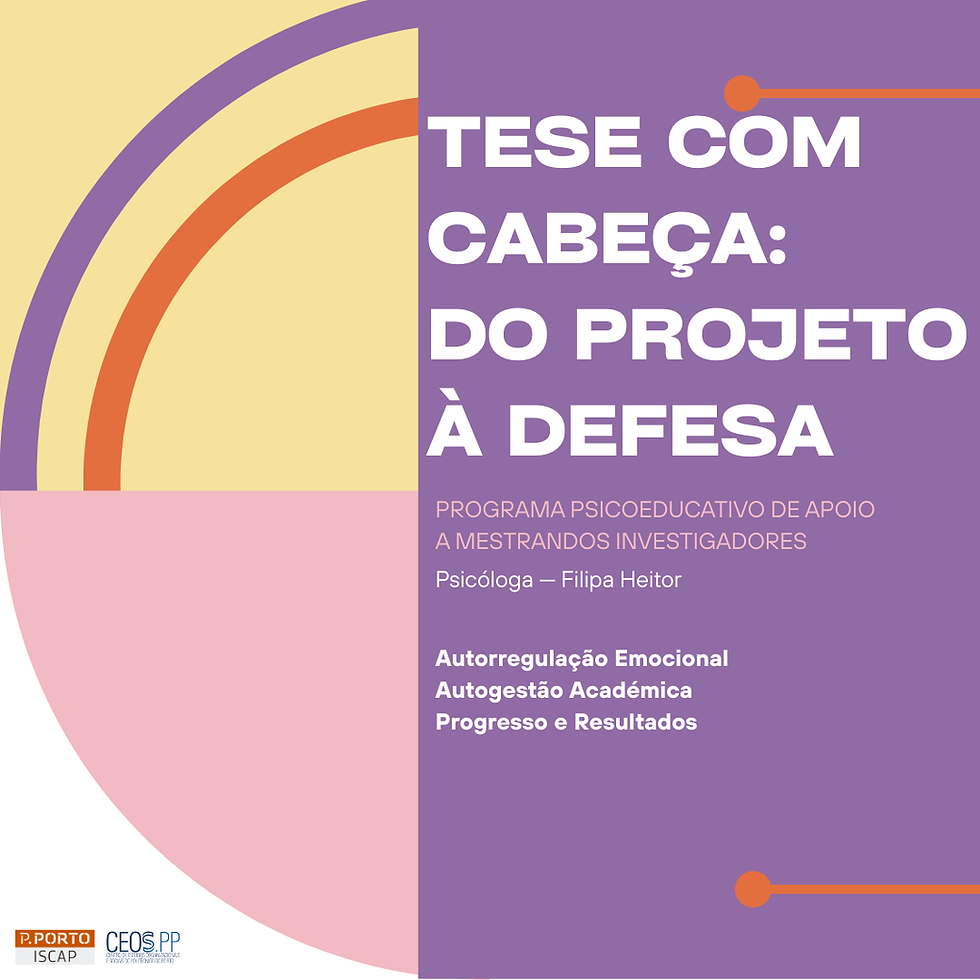
A Clear-Headed Thesis: From Project to Defense
Mon 09 Mar
|CEOS.PP Main Room
Psychoeducational Programme to Support Research
Time & Location
09 Mar 2026, 16:30
CEOS.PP Main Room
About the Event
Is anxiety writing more than you are?
You're not alone. The dissertation phase is demanding, and it was with this in mind that A Clear-Headed Thesis: From Project to Defense | Psychoeducational Programme to Support Research was created, promoted by CEOS.PP and ISCAP's Health and Well-being Promotion Office.
Led by Filipa Heitor, psychologist in charge of ISCAP's Health and Well-being Promotion Office, this programme aims to strengthen psychological skills essential to the academic path, promoting emotional self-regulation, academic self-management and adaptation to the demanding emotional, cognitive and organisational challenges of the Master's degree.
Throughout the sessions, participants will develop strategies that promote psychological well-being, help prevent academic burnout and increase the chances of success in research and completion of the Master's programme.
TARGET AUDIENCE
ISCAP Master's students from any scientific field, in the process of preparing a project or dissertation, interested in developing emotional management, organisational and academic resilience skills.
FORMAT
Free, subject to prior registration
7 fortnightly sessions, on Mondays (90 minutes/session)
Closed group of 8 to 15 students
Modality: In-person and online (Teams)
REGISTRATION
ORGANISATION
Health and Well-being Promotion Office (GPSB)
Centre for Organisational and Social Studies of the Polytechnic Institute of Porto (CEOS.PP)
FULL PROGRAMME
SESSIONS
9 March (4:30 p.m., in person)
23 March (12:30 p.m., online)
13 April (12:30 p.m., in person)
27 April (12:30 p.m., online)
18 May (12:30 p.m., in person)
8 June (12:30 p.m., online)
29 June (4:30, in person)
Session 1 — Starting point: mapping my potential
• Exploring expectations and goals;
• Normalising common difficulties in research;
• Identify initial skills and needs;
• Analyse work patterns and personal habits.
Session 2 — Charting the course: strategic roadmap
• Build a personal research roadmap;
• Set short- and medium-term goals;
• Reflect on academic identity and career;
• Apply psychological strategies to manage emotions and set micro-goals that optimise planning and attention.
Session 3 — Managing obstacles: conscious decision-making and action
• Recognise patterns of procrastination, avoidance and self-criticism (impostor syndrome);
• Explore conscious decision-making techniques;
• Develop strategies for overcoming blocks, insecurities, and indecision.
Session 4 — Focus and rhythm: organisation and sustainable results
• Develop time and energy management strategies;
• Apply conscious productivity techniques (such as batch work), ensuring consistent progress and well-being.
• Reflect and set priorities to balance research, writing and personal/professional life.
Session 5 — Resilience in action: stress under control
• Develop coping resources, integrated relaxation and mindfulness strategies;
• Strengthen personal resources for managing stress and anxiety;
• Reflect and adjust internal and external expectations.
Session 6 — Strategic support networks: communication and growth
• Support the development of strategies to manage and enhance relationships with supervisors and colleagues;
• Identify and mobilise other sources of support;
• Develop strategies to receive and use constructive feedback in an adaptive way;
• Encourage collaborative learning and community building.
(this session may be co-facilitated by a former Master's student)
Session 7 — Continuity cycle: consolidating and sustaining
• Review your personal roadmap and reflect on your progress;
• Consolidate healthy habits for well-being and productivity to sustain emotional balance after your dissertation.
INDEPENDENT WORK BETWEEN SESSIONS
Between sessions, participants will be invited to do short practical exercises.